《Rocket Cat》Kittens and Fat Cats Fall at the Same Speed/Why Cats?
Advertisement
One beautiful summer day in the historic Italian city of Pisa, two cats, Cassie and Henri (who despite the name is a girl) are visiting the top of its famous tower. Cassie, a small rambunctious kitten who's had quite enough history for one day keeps running around and leaping onto the wall at the edge of the tower. Henri, an older and larger (don't call her fat) cat who sees it as her duty to educate the young kitten is soon exasperated with her antics.
Hoping to teach the youngster a lesson, Henri leaps in front of her. Unfortunately, Henri is not the most agile cat and the two of them tumble over the side.
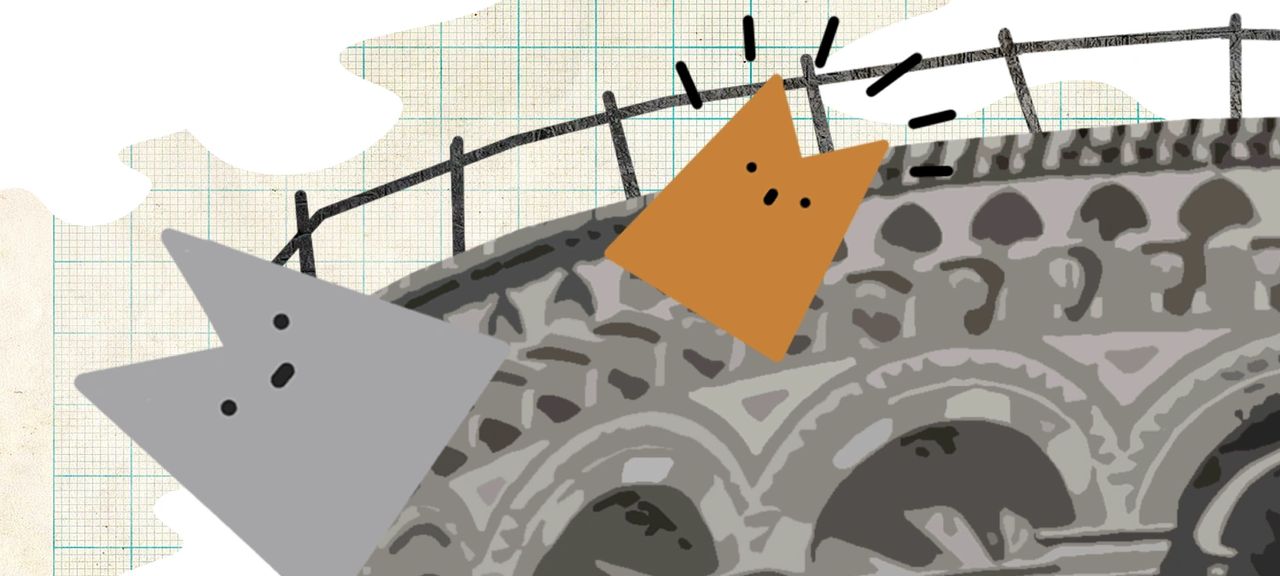
Needless to say, Cassie isn't pleased by this turn of events and her thoughts turn to self-preservation. Henri's bigger than me so she'll land first and maybe cushion my fall. However, to Cassie's dismay, she turns to see Henri right next to her falling at the exact same speed.
“Why aren’t you falling faster than me?” she yells.
“Physics,” exclaims Henri stretching a paw upward.
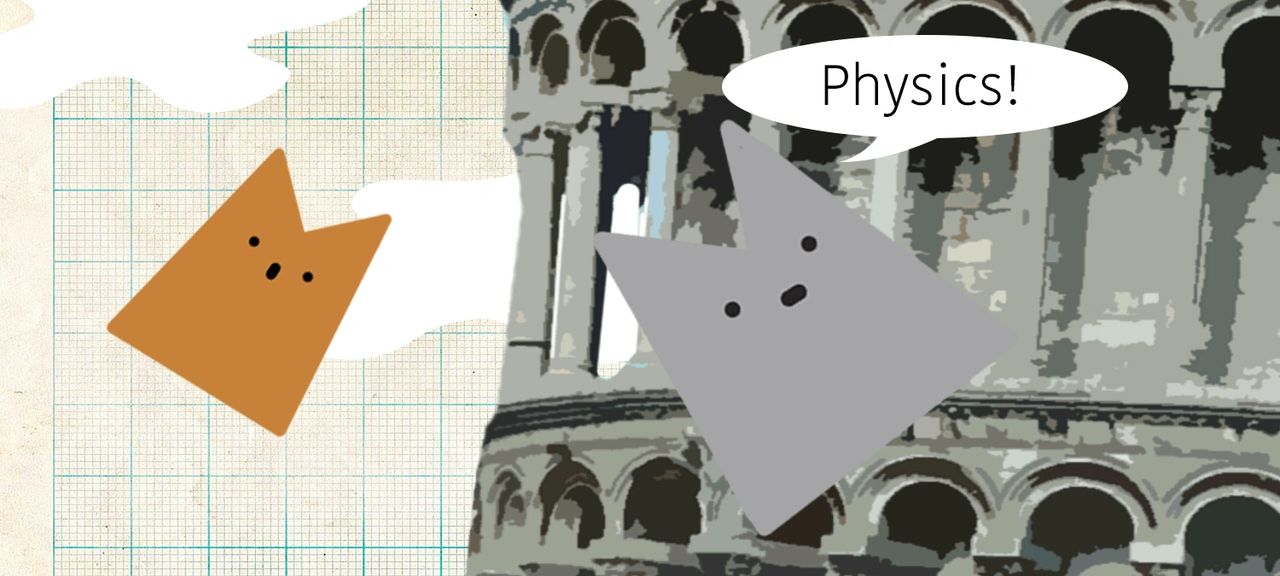
“Curse you physics,” mutters Cassie as the two cats plummet to the ground below.
Fortunately for our two feline friends, the Italian government had recently lifted its restrictions against children’s birthday parties near historic landmarks and they land unharmed on a large inflatable bounce house set up for just such an occasion.

In trying to teach Cassie a lesson, it was Henri who learned one. Realizing now that kittens sometimes just need a break from all the education, Henri decides to take Cassie to a nearby beach. Here the older cat finds a nice sunny spot and takes a nap to calm her nerves while the young kitten runs about chasing sea gulls and imagining herself to be a mighty lion.

Cassie’s confusion about falling objects isn’t all that unusual. If you have a heavier object, doesn’t gravity pull on it harder causing it to fall faster? This was the view of the ancient Greek scholar Aristotle. The famous Italian scientist Galileo proved him wrong in 1589 when he dropped objects (no, not cats) of different mass off the Leaning Tower of Pisa and they reached the ground at the same time (some say this didn't actually happen, but my cats tells me otherwise so I'll believe them).
Advertisement

However, it wasn’t until nearly a century later that it could be shown why Galileo was right. That’s when Isaac Newton published his discoveries about gravity (discovered when a cat fell out of a tree and onto his lap) and the laws of motion. Let’s consider what happens when Cassie and Henri fell from the tower. Be warned that there are some equations ahead. Read them quickly and it will hurt less.

That falling cat gave Newton an idea and like any good scientist, he turned that idea into math. After much scribbling and spillage of ink he came up with (dun dun dun) the equation for gravitational force.
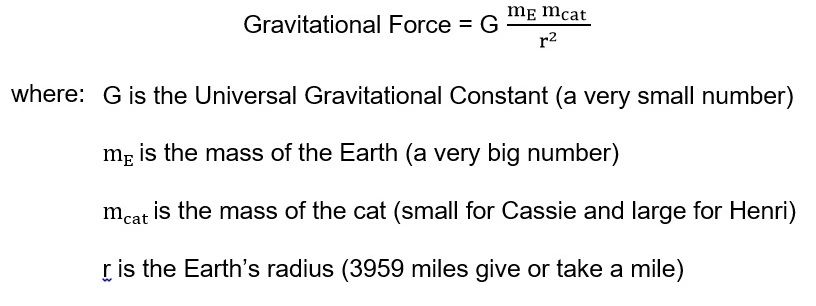
Now I'm no mathematician, but even I can tell from that equation that more gravitational force will act on Henri because she's heavier (not fatter mind you) than Cassie. So shouldn't Henri fall faster? Maybe we misjudged Aristotle. Just kidding. Actually, the force acting on each cat is only part of the story.
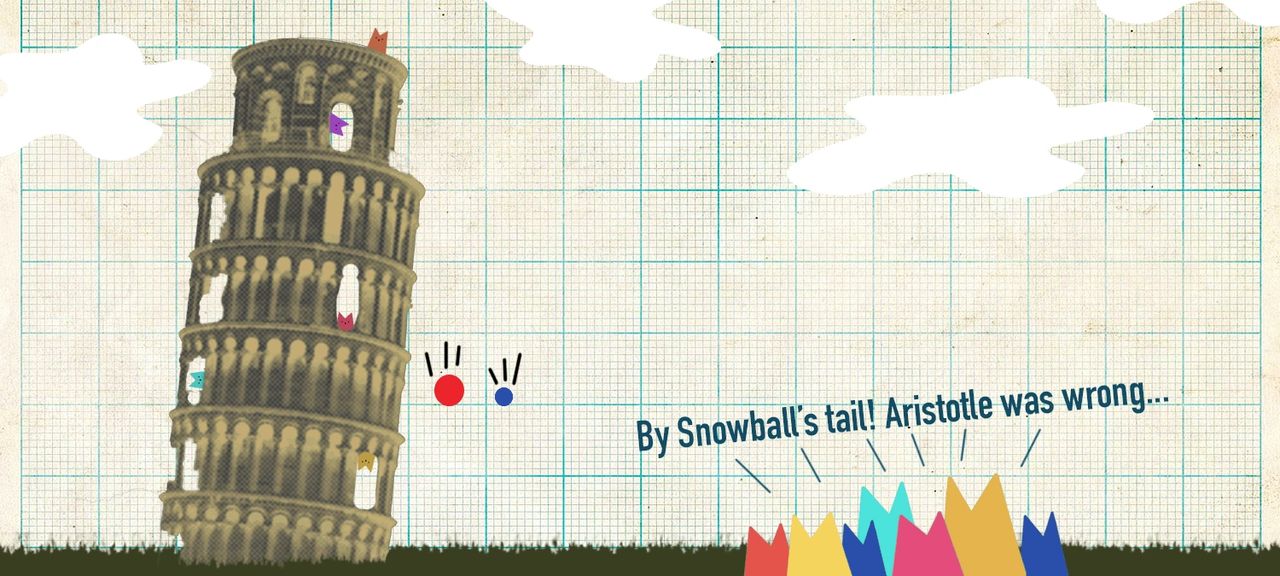
As the cats plummet to the ground below, their speed increases. The amount that their speed changes every second is what’s known as acceleration. A car going from 0 to 60 miles per hour in 6 seconds (don’t try this at home) is a common example of acceleration. And do you know what’s causing the cats to accelerate, our old friend gravity.
Newton’s Second Law of Motion (violators will be prosecuted) states that the force acting on an object is its acceleration times its mass. You know that famous F = ma thing.
Hey, didn’t we just see an equation showing the force acting on a cat? (hint: look up a couple of paragraphs if you dare) Why yes we did. Thanks to the magic of mathematical manipulation (a little substitution here, some cancellation there) we get.

Notice that since the acceleration has nothing to do with the mass of the cats, it’s the same for both of them. Since both cats have the same acceleration, they will fall at the same speed. If you plug in all the numbers in the above equation you get a gravitational acceleration of 32.174 feet per second squared. Any object you drop will have this exact same acceleration and so fall with the same speed.
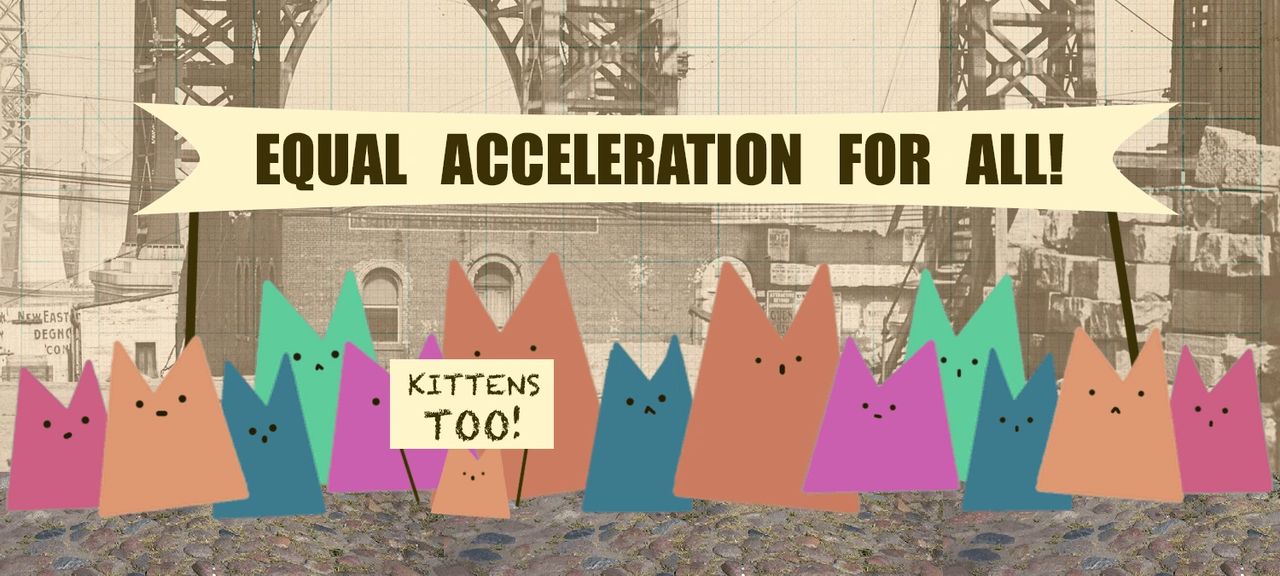
As is usual in these sorts of discussions, we assume that gravity is the only force acting on the cats. That means no air resistance, jet packs, or levitating spells. Think air resistance doesn’t matter, try dropping a feather. If that same feather is dropped in a tube with all the air removed, it will fall just as fast as a bowling ball (watch your feet).
Advertisement

You may have noticed (or maybe not, which is why I’m mentioning it here) that up to now I’ve always used the word mass as opposed to weight. There’s a reason for this: weigth and mass aren't the same. When we step on a scale, it measures the gravitational force acting on us, our weight. From Newton’s Second Law of Motion, that force is the gravitational acceleration multiplied by our mass. Thus our weight is a function of the gravity of the planet we’re on.
For example, Henri weighs 18 pounds (don’t tell her I said anything) here on Earth, but on the Moon she’d only weigh 3 pounds (she’d like that). However, her mass is the same in both places. Her actual mass is 0.56 slugs (yes that’s what mass units are called) and is the same wherever she may go.
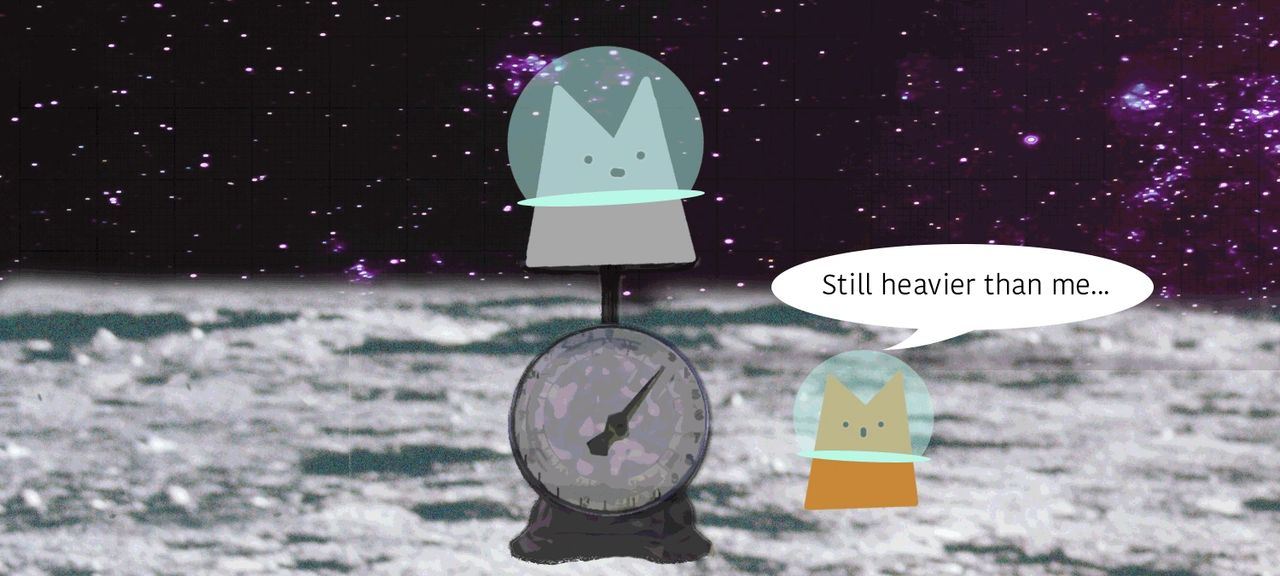
We now leave our two cat friends to their relaxing day on the beach after their harrowing experience. Hopefully they’ve both learned something from it just as we have.
Why Cats?

You’ve probably noticed that all the stories in this collection are about cats. I suppose we could have used almost any animal (penguins perhaps?), but why would we do that when cats are nearly synonymous with science. Think I’m exaggerating? Read on and be amazed.
Let’s start with the most famous cat in physics: Schrödinger's cat. In his famous thought experiment, Austrian physicist Erwin Shrodinger sought to demonstrate the concept of quantum superposition. This is the idea that a subatomic particle can simultaneously exist in multiple possible states, but the act of observing the particle causes it to revert to a single state.
In his example, Schrödinger postulated that a cat be placed in a box with a radioactive element which randomly may or may not decay. If it did decay, poison would be released into the box killing the cat. However, if there was no decay, the cat would be fine. From a quantum standpoint, the cat would be both alive and dead while the box is sealed. However, when the box is opened, one would see either a living or dead cat. Glad this was merely a thought experiment. See how the mere act of adding a cat made this complicated physics principle easy to understand.
Schrödinger's cat wasn’t the only one to impact physics. It’s a little known fact, but Isaac Newton’s cat Hermes was instrumental in helping him discover the law of gravity. What do you think Newton was doing under that tree when the apple hit him in the head? Scratching Hermes behind the ears. And Einstein’s cat Fluffipoo (yes Einstein was a tad eccentric) was his constant companion as he derived the Theory of Relativity. Fluffipoo’s encouraging purrs and head butts kept Albert going when he was on the verge of giving up. Their place in the history of physics alone warrants the their presence in these stories, but there’s still more. (Editor’s Note: The information in the preceding paragraph was provided by a cat so it may not be entirely true.)
Just look at some common cat activities: knocking things off tables, batting balls and other objects about, and chasing laser pointers. This isn’t just a cat’s way of entertaining itself, but physics experiments. Look at the physics principles involved: gravitational acceleration, inelastic collisions, momentum transfer, and the refractive properties of light. And there is yet more.
Ever wonder why cats sometimes just seem to be staring into space? Well believe it or not, they’re contemplating free-body diagrams, equations of motion, force calculations, and mass moments of inertia. Impossible? Just look at what cats are capable of: always landing on their feet, leaping with incredible accuracy, and demonstrating amazing balance while walking on narrow ledges. That’s not even accounting for their incredible ability to manipulate time and space. There can be no doubt that cats have mastered physics.
Considering all this evidence, we had no choice but to use cats.” “Why cats?” isn’t the question we should be asking. Instead, the question should be “Why in the world would you use any animal other than cats?”
Advertisement
- In Serial130 Chapters

Katarina the Witch Hunter: The Complete Collection
Katarina is a Witch Hunter, a free-ranging bounty hunter seeking out Witches, unsanctioned mages for the theocratic Anglish Empire; the empire of the Golden Lady, Goddess of the Dawn. Allies and enemies alike lurk in the towns, cities, and very forests of the continent where Katarina plies her trade. This collection contains all nine books previously separate.
8 142 - In Serial18 Chapters
Silent Calamity
A night of heavy drinking ends poorly for Ryan when he finds himself waking up in an unfamiliar home the following morning. He has no memory of how he got here, his phone keeps receiving strange messages, and to top it off, the seemingly unassuming neighborhood is revealed to harbor horrific creatures that should have no business existing in reality. Creatures he’s left with no choice but to face head-on. Ryan’s survival will depend on his ability to overcome his fears, adapt to the strange system of his new environment, and grow in power to stay ahead of the rising curve. Along the way, he’ll make allies, clash with enemies—both monsters and human alike—and perhaps even begin to uncover the mysteries of this world and how he came to be here.
8 219 - In Serial7 Chapters
Schwarzesmarken '86
3 years after the dramatic conclusion of the Stasi coup attempt, Theodor Eberbach, who had made a new life for himself in the United Kingdom, returns to mainland Europe following rumors of the survival of Katia Waldheim as humanity is pushed back to a few strongholds by the BETA. Originally written for Muv Luv threads on a certain imageboard, I'm posting it here so I don't lose it. Don't expect me to finish this as it has been around 2 years since I worked on it and I am working on an original writing project, but some feedback would be appreciated.
8 85 - In Serial78 Chapters
Once again king's obsession and love
Other version of king's obsession
8 483 - In Serial15 Chapters
Ginelle's Dragon
Ginelle had no choice but to run away from home as the crown and the church start to round up and imprison all the witches in the kingdom. While hiding out, she befriends a few new friends including a dragon that agrees to protect her as they happen to have a common enemy.
8 131 - In Serial89 Chapters
A Twist Of Marvel || Infinity War
"KNOWLEDGE IS POWER, BUT IGNORANCE IS BLISS."Naomi Swanson is fresh out of college, working as an assistant in a small paper supply company and inhaling coffee by the gallons. When an accident knocked her out, Naomi woke up in a world she had only seen through screens.Armed only with her phone and a questionable data plan, Naomi attempts not to be killed as she comes face-to-face with the Avengers, and so much more.Winner in Fanfiction Category | Watty Awards 2020Cover by @zaramartinez-Spanish Translation available: @CrazyCattGirl Infinity War Spoilers!Disclaimer: Some explicit language will be used throughout this book. Do not read if you cannot handle light swearing. No sexual content.Disclaimer pt. 2: I do not own Marvel or any of the characters aside from Naomi Swanson. (Don't sue me Disney.)
8 238


 Prev Chap
 Next Chap
 Chap List
 Boy
Boy Girl
Girl